 By Chris Liversidge ·
23rd July, 2025
· SEO
By Chris Liversidge ·
23rd July, 2025
· SEO


We have seen an incredible shift in search optimisation dynamics over the last twelve months that reminds me of the very early days of Search which generated big winners and losers.
We are a long way from the days of eBay running ads with unlimited budget matching literally any search term you could think of, creating much fun for marketers who triggered ads for ‘old rope’, ‘perpetual motion machines’, a ‘wife’ or the more existential: ‘love’. And this was not unusual at the time, though eBay had the most headlines due to their budgets.

However I think the dynamics of change in search are today as strong as they were back in the early days. We are in the middle of the ‘Great Decoupling’ according to most search marketers and indeed even in the words of Google themselves. This is what that looks like:
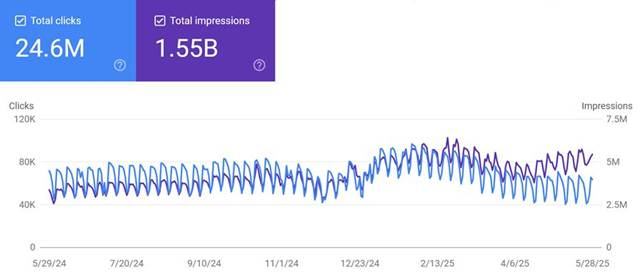
The Googler in question, Martin Splitt described this decoupling and when asked about where those clicks were going said:
“It’s similar to what happened with impressions many years ago – you got impressions that lead to nothing (while probably not getting ones that might have lead to something).
We’re seeing that clicks might stagnate or go down, but either people convert later in the customer journey, without search involved in the later stage directly (no search click, but still a conversion, despite nearly impossible to attribute to an earlier impression). And the clicks you get through search are more likely to be clicks that convert.”
Though Martin then acknowledged that he wasn’t able to offer any good data or foundations for his belief that clicks would eventually come from other channels.

+£64m Revenue YoY
Technical SEO & migration management of the T-Mobile & Orange migration to EE delivered a year on year uplift of £64 million.
Described byGoogle as:
"The best managed, most thorough and successful large scale migration in the UK to date."
Find out how we could do the same for you with our Technical SEO Services.

This is an area I have analysed when looking at digital marketing in 2025 and the data we have does indeed suggest we can build overall volume very effectively by targeting content towards AI overviews, especially given the volume of citations from pages outside the top 10 results being heavily cited by AI overviews.
However, when we look at Search in isolation, how can we take this dynamic of declining clicks and build best in class foundations for Search optimisation in our AI age?
Well to do so, we need to understand the dynamics affecting our core measure of optimisation: efficient performance that drives incremental growth.
Let’s start with the CPC.
The Decade of the Rising Click: Unpacking the Forces Behind CPC Inflation in Paid Search
Over the past ten years, advertisers navigating the complexities of search engine paid media have faced a consistent and often challenging trend: the relentless rise of Cost-Per-Click (CPC). This inflation is not the result of a single cause but rather a confluence of factors, including intensified competition, evolving search engine algorithms, shifts in user behaviour, and broader economic pressures.
Here is a view of the last decade average CPCs in the US marketplace for which we have the most robust benchmark data:
Paid Search CPC vs. Consumer Price Index (CPI) Inflation, 2015–2025 (YoY % Change)
| Year | Average Search CPC (US) | YoY % Change in CPC | Average Annual CPI-U (All Items) | YoY % Change in CPI |
|---|---|---|---|---|
| 2015 | $2.32 | – | 237.017 | 0.1% |
| 2016 | $2.69 | +15.9% | 240.007 | 1.3% |
| 2017 | $2.90 | +7.8% | 245.120 | 2.1% |
| 2018 | $3.20 | +10.3% | 251.107 | 2.4% |
| 2019 | $3.50 | +9.4% | 255.657 | 1.8% |
| 2020 | $3.80 | +8.6% | 258.811 | 1.2% |
| 2021 | $4.00 | +5.3% | 270.970 | 4.7% |
| 2022 | $4.60 | +15.0% | 292.655 | 8.0% |
| 2023 | $4.22 | -8.3% (re-benchmarked) | 304.702 | 4.1% |
| 2024 | $4.66 | +10.4% | 314.055 | 3.1% |
| 2025 | $5.26 | +12.9% | 322.561 (June) | 2.7% (June YoY) |
Note: CPC data is compiled from multiple benchmark reports and includes estimations for years where direct comparable data was unavailable. CPI data is from the U.S. Bureau of Labor Statistics. The 2023 CPC shows a drop due to re-benchmarking in source data but the overall trend remains upward.
A deep dive into the dynamics of Google Ads reveals a multi-faceted landscape where advertisers are paying more for each click than ever before. Here are the primary drivers behind this decade-long trend:
CPC Cost Driver #1: Increased Competition
The most significant factor driving up CPCs is the sheer volume of businesses vying for the same ad space. The last decade has seen an unprecedented shift to online, accelerated by the global pandemic.
As more companies embraced digital marketing, the demand for valuable keywords has surged, turning the ad auction into a more crowded and expensive marketplace. This increased competition means advertisers are willing to bid higher to secure top positions, directly inflating CPCs across most industries.
The digital search advertising market is not a monolith however; it is dominated by Google, with Microsoft Advertising serving as a significant, albeit smaller, competitor – and it is here that we can see the true impact of competition.
While both have experienced cost increases, Microsoft Ads consistently offers lower CPCs, making the gap between the two a powerful indicator of the intense auction pressure on Google.

Increase Organic Revenue by 18.7%
Following a rebranding project, Wolseley wanted to grow their authority within the trade industry and increase organic traffic to key product areas.
QueryClick implemented brilliant basics to supercharge organic performance and deliver a huge 18.7% uplift in organic revenue.
Reach out to our team and find out how much we could increase your revenue today.
In 2025, our benchmark data shows that the average CPC on Microsoft Advertising falls within the range of $1.50 to $2.80. This stands in sharp contrast to Google Ads, where the average CPC range is $2.85 to $5.26. This differential translates to a typical cost saving of 30% to 70% for advertisers on the Microsoft platform. Another analysis of our benchmarking data reinforces this, with a 42% CPC discount on Microsoft Ads compared to Google Ads (an average of £1.17 vs. £2.0).
This persistent price gap is a direct function of market share and competitive saturation. Google commands the vast majority of the global search market. The volume of advertisers competing on Google creates a hyper-competitive auction environment that naturally drives up prices. The widening gap between the two platforms over time is effectively an auction pressure index. As this index ratio grows, it signals that the cost of competition on Google is escalating at a faster rate than on other platforms. This dynamic elevates a multi-platform strategy that maximises Microsoft Advertising media spend allocation from merely being a nice-to-have to a strategic necessity for sophisticated advertisers seeking to manage their blended CPC and overall media efficiency.
CPC Cost Driver #2: Algorithmic Evolution and Ad Rank Dynamics
Search engines continually refine their algorithms to improve user experience and ad relevance. A key development over the last decade has been the evolution of Ad Rank.
The modern Ad Rank formula is a dynamic, auction-time assessment driven by:
- Your Bid: The maximum amount an advertiser is willing to pay.
- Ad & Landing Page Quality: This includes factors like ad relevance to the search query, expected click-through rate (CTR), and the user experience on the landing page.
- Ad Rank Thresholds: Minimum quality and bid levels an ad must meet to be eligible to show at all, or in specific positions (e.g., top of page).
- Auction Competitiveness: The Ad Ranks of other advertisers in the same auction. A larger gap between your Ad Rank and a competitor’s increases your probability of winning but may also increase your actual CPC.
- Context of Search: This is a crucial and expansive category of real-time signals, including the user’s location, device type (mobile vs. desktop), time of day, the specific nature of the search terms, and other ads and results on the page.
- Expected Impact of Ad Assets: Formerly known as ad extensions, this component evaluates the performance impact of including additional information like sitelinks, callouts, structured snippets, and phone numbers.
The introduction of “Ad Assets” as a direct Ad Rank component was a pivotal change.
This effectively raised the competitive stakes, rewarding advertisers who invest the time and effort to create more comprehensive and informative ads. An ad with robust, relevant assets will achieve a higher Ad Rank than a basic ad with the same bid and core quality, forcing competitors to either improve their own assets or increase their bids to keep pace.
Similarly, the explicit inclusion of numerous “Context” signals means the auction is no longer a static evaluation but a fluid, real-time calculation unique to every single search. This complexity makes it harder for advertisers to rely on simple bid adjustments and pushes them towards more – sophisticated – and often more expensive – strategies to cover all contextual bases.
On which point…
CPC Cost Driver #3: The Rise of Automated and AI-Driven Bidding
The introduction and widespread adoption of automated bidding strategies by Google have fundamentally changed how advertisers manage their campaigns. While these tools offer efficiency and can optimise for conversions, they also contribute to CPC inflation.
Machine learning algorithms, designed to achieve specific goals like maximising conversions or conversion value, are often willing to bid higher in auctions deemed likely to convert. This can drive up the average CPC, as the system prioritises performance over the lowest possible click cost.
The gradual rollout and increasing sophistication of these “Smart Bidding” strategies has been a significant factor in CPC cost inflation. Google has heavily promoted bid options like Maximise Clicks, Maximise Conversions, and now of course Target CPA (tCPA), and Target ROAS (tROAS), which are designed to simplify bidding by using machine learning to set bids for every individual auction in real-time.

While these strategies offer undeniable benefits in efficiency and performance for many advertisers – and have become essential as our access to keyphrase level optimisation data has been removed – they also function as a powerful accelerant for CPC inflation.
For example, Maximise Conversion bid strategies are explicitly programmed to spend the advertiser’s full daily budget to achieve target. This means the algorithm has the latitude to bid very aggressively, driving CPCs significantly higher, in auctions where it calculates a high probability of a conversion. The removal of the previous 30% bid adjustment cap on Enhanced CPC (ECPC) is a clear example of this principle in action; the algorithm can now raise a bid by any amount it deems necessary to secure a conversion, prioritising the outcome over a specific cost-per-click.
This creates a systemic inflationary pressure across the entire ecosystem.
When the majority of competitors in a given vertical adopt automated, conversion-focused bidding, they are in effect, unleashing legions of AI agents programmed to outbid each other for the most valuable users. This results in a competitive feedback loop: Advertiser A‘s AI bids up to win a valuable click. Advertiser B‘s AI observes this and learns that a higher bid is now required for that type of auction. In the next similar auction, both algorithms start from a higher bidding baseline.
This process, repeated millions of times a day, continuously ratchets up the market rate for a click, contributing significantly to overall CPC inflation.
CPC Cost Driver #4: Evolving Search Engine Results Pages (SERPs)
The visual layout of the SERP has undergone a dramatic transformation. A decade ago, the distinction between paid and organic results was more pronounced. Today, ads are more integrated, often appearing larger and with more extensions, blurring the lines for users. Furthermore, Google has at times reduced the number of ad slots on the first page, particularly on desktop. This scarcity of prime real-estate intensifies competition for the remaining spots, naturally driving up the price advertisers are willing to pay.
In February 2016, Google enacted one of the most significant SERP redesigns in its history, permanently removing all text-based ads from the right-hand sidebar on desktop search results. Simultaneously, it increased the maximum number of ads that could appear at the top of the page for queries deemed “highly commercial”.
The impact was immediate and profound.
The change dramatically reduced the total number of available ad slots on the first page, shrinking the inventory from a potential maximum of 11 to just seven. This artificial constriction of supply instantly made the remaining top-of-page positions more scarce and, therefore, more valuable. Competition for these premium slots intensified overnight.
The 2016 ad layout change was part of a broader, decade-long trend of commercialising the SERP and reducing the prominence of traditional organic results. The addition of a fourth top ad pushed the first organic listing further down the page, often below the fold. This trend has only accelerated with the proliferation of new SERP features, such as Featured Snippets (2014), People Also Ask (2015), Video Carousels (2018), and, of course, AI Overviews (2024).
Each of these features occupies valuable screen real estate at the top of the page, further marginalising the “ten blue links” of organic search. This phenomenon has had a direct impact on CPC inflation.
Taken in combination with our next cost driver, this layout change lays claim to be the largest overall pressure on rising CPCs.
CPC Cost Driver #5: The Mobile Revolution and Cross-Device Targeting
The explosion in smartphone usage over the past ten years has led to a mobile-first world.
Initially, mobile CPCs were often lower than their desktop counterparts. However, as user engagement and conversion rates on mobile have improved, and as search engines have refined mobile ad formats and targeting, the value of a mobile click has increased. The introduction of mobile-first indexing and the need for a seamless cross-device experience have also added layers of complexity and cost to campaign management.
The last ten years have been defined by the inexorable rise of the mobile web.
Recognising this shift, Google initiated a series of updates designed to force the digital world to reorient itself around the mobile user. The process began in earnest with the April 2015 “Mobilegeddon” update, which for the first time explicitly made mobile-friendliness a direct ranking signal for searches conducted on mobile devices. This was the first clear signal to businesses that a poor mobile experience would come with a rank penalty, though my experience with SEO has always shown page speed to be a critical underlying ranking factor, and sites which were well optimised for mobile would consistently outrank sites that didn’t even before 2015, as I have written about extensively on Search Engine Land.
This evolution ultimately culminated in the full, global rollout of mobile-first indexing, a process that began with testing in 2016 and was officially completed for all websites by October 2023.
The dominance of mobile is not just a matter of indexing: it’s a matter of traffic volume.
By 2025, mobile devices account for over 63% of all global web traffic and a similar share of organic searches. This sheer volume of mobile users, who often exhibit different search behaviours and higher commercial intent than their desktop counterparts, has created a distinct and highly competitive mobile advertising auction.
This intense competition has given rise to a “mobile premium” on CPCs. While data can vary by industry and year, multiple analyses point to mobile clicks being more expensive.
Advertisers are willing to pay this premium because mobile clicks can be incredibly valuable. Mobile users are often further down the purchase funnel, looking for immediate solutions or local businesses. Features like “click to call” in mobile ads are used by 70% of mobile e-commerce customers, indicating a strong intent to act. Furthermore, Statcounter data suggests mobile ads can achieve 40% higher click-through rates (CTRs) than desktop ads. The combination of high user volume and high commercial intent justifies the higher cost for many advertisers, creating a sustainable market dynamic where mobile CPCs remain elevated.
In summary: the implementation of mobile-first indexing has forged a direct and unbreakable link between mobile user experience and paid search costs. Factors that were once considered purely in the domain of SEO or web development are now critical inputs into the Ad Rank calculation. The “landing page experience” component of Ad Rank is, in a mobile-first world, synonymous with the mobile landing page experience.
This means that technical performance metrics are now direct cost factors. Google’s Core Web Vitals – Largest Contentful Paint (LCP), Interaction to Next Paint (INP), and Cumulative Layout Shift (CLS) – are measures of a site’s loading performance, interactivity, and visual stability. A site that performs poorly on these metrics will receive a lower landing page experience score, which in turn lowers its overall Quality Score.
The financial consequences of a low Quality Score are severe. It acts as a multiplier on an advertiser’s CPC. According to Instapage, accounts with a Quality Score of 4 or lower (out of 10) can see their CPCs increase by anywhere from 25% to a staggering 400%. Conversely, accounts with a high Quality Score of 6 or more can receive a CPC discount of 16-50%.
CPC Cost Driver #6: Enhanced Targeting and Audience Segmentation Compounded by Loss of Data Access via Data Privacy
The ability to target specific demographics, interests, and user behaviours had become increasingly granular in the early parts of the last decade. While this allowed for more effective advertising, it also means that advertisers are competing for highly valuable, and therefore more expensive, audience segments, naturally driving up CPCs in search, but delivering better converting traffic.
The layering of audience data on top of keyword targeting creates a more competitive auction for the most desirable potential customers, in an auction environment, this creates cost. However the collection and usage of 1st party data is now more challenging that it has ever been thanks to privacy regulations like GDPR, DPA & CCPA, meaning many are paying more for smaller audiences than ever before.
In addition, Paid Social has had its own costs heavily impacted by Apple’s App Tracking Transparency (ATT), causing previously cheap traffic in the first half of the last decade to become more expensive due to loss of audience targeting signals.
Media Spend in Social that had been used to generate new customers cheaply in Social has been funnelled into Search – trying to capture that same upper funnel incrementality in the more expensive generic search term marketplace – driving yet more advertising competition into Search and further inflating CPCs.
These shifts have had a ripple effect across the digital landscape. As some channels become less effective due to data restrictions, advertisers may further reallocate budgets to search, increasing competition and potentially driving up CPCs.
This compounding effect has been accelerated by the mass loss of measurement created by data privacy, meaning that legacy analytics systems like GA4 and Adobe Analytics fail to measure and connect data from earlier stages in customer conversion journeys as they switch across devices at increased frequency.
What this means in practice is that capturing new, incremental traffic is increasingly expensive using data from these legacy platforms – innovation like AI based stitching allow top of funnel activity to be rediscovered in digital data as can be seen again, and again, and again.
So perhaps in our deep-dive into causes of the inexorable rise of CPCs there is a glimmer of technological hope for advertisers to level the playing field for their advertising dollars after all…
If you are interested in a deep dive on AI and digital marketing optimisation, get in touch today.
Client Experience


Author

